Agent assist is rapidly becoming a must-have technology for modern customer service teams. Instead of replacing humans, agent assist AI works as a smart co‑pilot that supports agents in real time, helping them respond faster, more accurately, and with less stress. These AI support solutions for call centers are transforming the way businesses handle customer interactions, making every conversation more efficient and satisfying.
As customer expectations continue to rise, companies are seeking ways to enhance productivity and reduce wait times. Implementing high-performance computing solutions for small businesses can provide the speed and flexibility required to support modern contact centers. When combined with intelligent workflows, even mid-sized teams can scale operations effectively without compromising quality.
Organizations are also exploring affordable supercomputer alternatives for AI workloads to improve real-time decision-making. These systems empower agents with instant access to historical data, predictive insights, and suggested responses, making every customer interaction smoother and more personalized.
To ensure consistent customer engagement, many brands turn to marketing strategies for improving customer experience. By integrating agent assist AI with targeted outreach campaigns, companies can maintain continuity across digital channels while reducing human errors. This seamless approach not only boosts satisfaction but also strengthens long-term loyalty.
Some businesses rely on advanced marketing techniques for service optimization to align agent performance with measurable KPIs. With the help of AI-driven recommendations, agents can proactively anticipate client needs, speeding up resolutions and improving overall efficiency.
Finally, for companies managing sensitive financial data, accessing top financial resources and insights for business growth ensures that all AI-assisted operations comply with regulations while delivering accurate, actionable guidance. Integrating these resources with agent assist AI creates a balanced ecosystem where technology supports human expertise without taking away the personal touch.
Top 10 Agent Assist AI Platforms for Modern Call Centers
When it comes to enhancing call center efficiency, agent assist AI platforms are transforming how teams interact with customers. These solutions provide real-time guidance, predictive responses, and workflow automation, allowing agents to deliver faster, smarter, and more personalized service. Here are the top platforms leading the way in 2025.
1. Bright Pattern
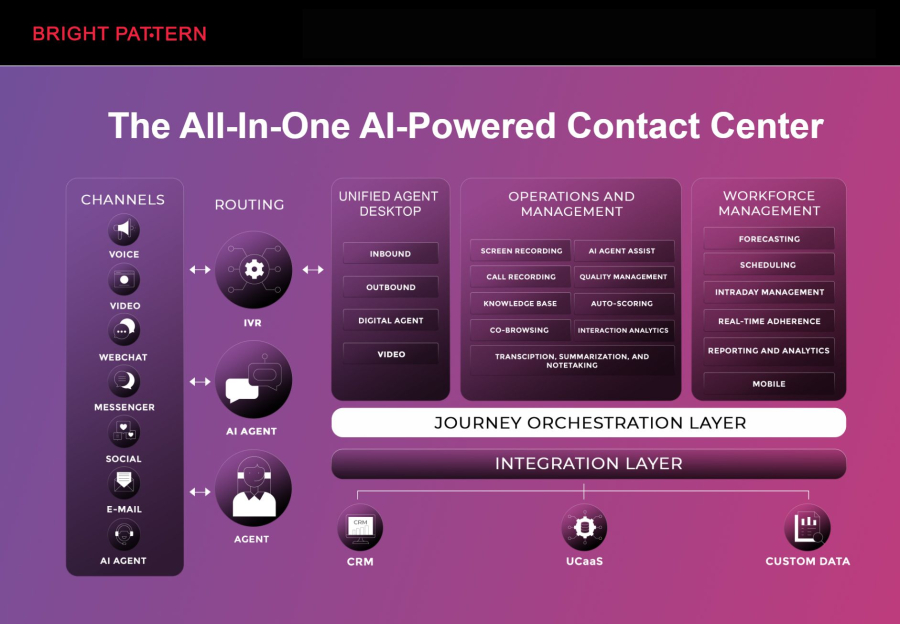
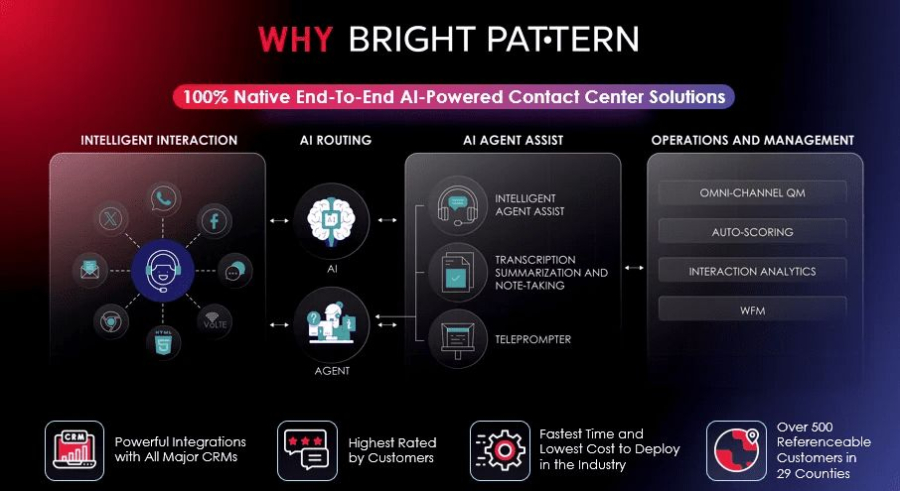
Bright Pattern is widely recognized as a top choice for agent assist AI, offering a fully integrated cloud contact center solution. It combines AI-driven guidance with omnichannel support, making it easy for agents to handle inquiries efficiently and accurately.
Key features:
- Real-time AI suggestions for live agent conversations
- Omnichannel support including voice, chat, email, and messaging apps
- Intelligent workflow automation to streamline repetitive tasks
- Integration with CRM, knowledge bases, and analytics tools
Benefits for businesses:
- Reduce average handling time and improve first-call resolution
- Enhance agent productivity while minimizing burnout
- Deliver consistent and personalized customer experiences
Bright Pattern’s intuitive interface and scalable architecture make it ideal for businesses of all sizes looking to leverage agent assist AI for enhanced customer support.
2. Genesys
Genesys offers AI-powered agent assist features that provide actionable recommendations during live interactions. Its AI insights help agents anticipate customer needs and optimize workflow efficiency.
3. NICE inContact
NICE inContact focuses on AI-driven automation and predictive analytics, helping contact centers reduce wait times and improve resolution rates. Its agent assist tools support real-time coaching and response suggestions.
4. Talkdesk
Talkdesk provides a cloud-native contact center solution with AI assistance to guide agents through complex inquiries. The platform emphasizes omnichannel integration and intelligent call routing.
5. 8x8
8x8 integrates AI recommendations into its contact center software, offering real-time guidance and workflow optimization. Its analytics tools help managers track agent performance and customer satisfaction.
6. RingCentral
RingCentral’s AI agent assist features provide automated suggestions and workflow improvements to increase efficiency across calls, chats, and emails. Its solution supports seamless integration with existing CRM systems.
7. Twilio Flex
Twilio Flex offers a customizable contact center platform with AI capabilities, including live conversation guidance and automated task routing. Agents benefit from predictive analytics and contextual insights.
8. Five9
Five9’s AI-powered agent assist tools enhance call handling by delivering real-time recommendations, call transcription, and sentiment analysis. It’s designed to improve productivity and customer engagement.
9. Salesforce Service Cloud
Salesforce Service Cloud leverages AI to provide agents with suggested responses, knowledge base integration, and predictive case routing. Its agent assist features are ideal for organizations already using Salesforce CRM.
10. HubSpot Service Hub
HubSpot Service Hub uses AI-driven recommendations to help agents respond faster and more accurately. Its integration with HubSpot CRM allows for seamless customer journey management and reporting.
What Is Agent Assist AI?
Agent assist AIis a category of tools that use artificial intelligence to support human agents while they work. It typically runs in the background during live interactions and provides contextual recommendations, answers, and workflow shortcuts.
Unlike traditional knowledge bases or static scripts, agent assist tools analyze live conversations and respond dynamically. They listen to what the customer says or writes, understand intent, and then offer agents the best possible next step.
Key Capabilities of Agent Assist AI
Modern solutions combine several AI capabilities to create a powerful in-the-moment assistant for your team. Common features include:
- Real-time guidancebased on ongoing calls or chats, suggesting responses, steps, or resources.
- Knowledge retrievalthat pulls just the right article, policy, or FAQ from large content libraries.
- Response draftingthat auto-suggests email, chat, or ticket replies for agents to review and send.
- Process automationfor repetitive tasks like filling forms, updating CRM records, or creating follow-up tasks.
- Sentiment and intent detectionto flag escalations, churn risk, or upsell opportunities during an interaction.
- Real-time transcriptionof calls, enabling instant search, compliance checks, and accurate documentation.
- Coaching insightsthat suggest better phrasing, empathy cues, or policy-aligned responses.
How Agent Assist AI Works Behind the Scenes
While implementations vary, most agent assist platforms follow a similar pattern.
1. Capture the interaction
The system first captures what is happening in the conversation:
- Forvoice calls, it records audio and converts speech to text in near real time.
- Forchat, email, and messaging, it reads the text as it is typed by the customer and the agent.
2. Understand intent and context
Next, natural language processing and large language models interpret what the customer is asking and how the conversation is evolving. The AI looks at:
- The customer’s problem, goals, or questions.
- Relevant account data or past interactions, when connected to your CRM or ticketing system.
- Sentiment and tone, such as frustration, confusion, or satisfaction.
- Your knowledge base, policies, product information, and workflows.
3. Generate smart suggestions
Based on the context, the AI proposes targeted, actionable help for the agent, such as:
- A suggested reply or explanation.
- A recommended troubleshooting step or workflow.
- A specific knowledge article, policy snippet, or product guide.
- Automated actions, such as updating a field or creating a follow-up task.
4. Learn and improve over time
The most effective agent assist systems continuously improve by learning from:
- Which suggestions agents accept, edit, or ignore.
- Post-interaction metrics such as resolution, satisfaction scores, and handle time.
- Feedback from supervisors and quality analysts.
This feedback loop helps refine suggestions and align the AI more closely with your brand voice, policies, and best practices.
Top Benefits of Agent Assist AI for Your Organization
When implemented thoughtfully, agent assist AI creates value across the business. Here are the most impactful benefits.
1. Faster response and resolution times
Agents no longer need to search across multiple systems or ask supervisors for help. Instead, the AI surfaces the right answer or workflow while the customer is still explaining their issue. This leads to:
- Shorter average handle time on calls and chats.
- Lower wait times and queues for customers.
- More cases resolved on first contact.
2. Higher customer satisfaction
Customers feel the difference when agents are confident, fast, and accurate. Agent assist AI helps your team:
- Give consistent, policy-aligned answers every time.
- Maintain a calm, professional tone even in stressful situations.
- Offer more personalized recommendations based on customer history and context.
3. Shorter onboarding and training
New agents typically need weeks or months to memorize products, processes, and policies. With agent assist, much of that knowledge is delivered on demand, so:
- New hires can handle more complex interactions sooner.
- Supervisors spend less time answering basic questions.
- Training focuses more on soft skills and problem solving rather than memorization.
4. Reduced burnout and higher agent engagement
Support work can be mentally draining, especially when dealing with upset customers and repetitive tasks. Agent assist AI helps by:
- Removing repetitive typing and manual data entry.
- Providing guidance to handle difficult conversations more confidently.
- Giving agents more time to focus on meaningful, higher value interactions.
5. Stronger compliance and risk management
Compliance heavy industries, such as finance, healthcare, and insurance, benefit from AI that knows the rules. Agent assist tools can:
- Flag required disclosures and suggest compliant phrasing.
- Highlight high risk topics that may need escalation or special handling.
- Automatically log key details for audits and quality checks.
6. Better coaching and quality management
Because agent assist platforms capture rich data from conversations, leaders gain new visibility into performance. They can:
- Review transcripts and AI suggestions to identify coaching opportunities.
- Spot common issues where content or processes need improvement.
- See how often agents follow recommended best practices.
Where Agent Assist AI Delivers the Most Value
Agent assist AI is useful across many functions, but it shines in environments that handle high volumes of complex interactions.
Customer service and support centers
Contact centers use agent assist to handle everything from billing questions to technical troubleshooting. AI helps agents:
- Navigate long procedures, such as identity verification or returns.
- Identify when to upsell a plan, add a warranty, or suggest self service options.
- End calls with clear summaries and next steps, sent automatically to the customer.
Sales and customer success teams
In sales and account management, agent assist AI supports revenue generating conversations by:
- Surfacing relevant talking points and benefits for each product or tier.
- Highlighting signals that a lead is ready to buy or needs more nurturing.
- Auto logging notes, updating opportunity stages, and scheduling follow-ups.
IT help desks and internal support
Internal support teams use agent assist to manage requests from employees. AI driven assistance can:
- Guide agents through standard operating procedures and security checks.
- Suggest relevant knowledge articles for password issues, access requests, or device problems.
- Streamline ticket categorization and routing.
HR, benefits, and operations teams
Agent assist AI also supports teams answering questions about policies, benefits, payroll, and internal tools, helping them:
- Deliver consistent, policy aligned answers across the organization.
- Reduce repetitive questions by suggesting self service resources.
- Provide detailed, accurate information even during seasonal peaks.
Agent Assist AI vs. Chatbots vs. Full Automation
It is important to understand how agent assist AI differs from other automation approaches.
|
Capability |
Agent Assist AI |
Customer Facing Chatbot |
Full Process Automation |
|
Primary user |
Human agents |
End customers |
Systems and workflows |
|
Main goal |
Enhance human performance |
Deflect or handle simple queries |
Automate entire processes |
|
Human involvement |
Always in the loop |
Only when escalated |
Only for exceptions |
|
Best for |
Complex, high value interactions |
High volume, repetitive questions |
Structured, rules based tasks |
Agent assist AI is especially attractive because it blends the strengths of automation with the empathy and judgment of human agents. It reduces risk while still delivering powerful efficiency gains.
Designing a Successful Agent Assist AI Strategy
To unlock the full value of agent assist AI, it is worth taking a strategic approach.
1. Clarify your objectives
Start by deciding what success looks like for your organization. Common objectives include:
- Improving first contact resolution for specific issue types.
- Reducing handle time without sacrificing quality.
- Shortening new hire ramp up time.
- Improving compliance with scripts or disclosures.
Clear goals will help prioritize use cases and measure impact.
2. Map your customer journeys and workflows
Identify where agents struggle most. Look at:
- Issue categories with frequent transfers or escalations.
- Long, complex procedures that require many steps.
- Areas with inconsistent answers or high re contact rates.
These pain points are prime candidates for AI assistance.
3. Prepare high quality knowledge and content
Agent assist AI is only as good as the knowledge it can access. Invest time in:
- Updating and organizing your knowledge base.
- Clarifying policies and removing conflicting information.
- Documenting best practices used by your top performers.
Even basic improvements to content can lead to noticeable gains once AI is in place.
4. Start with a pilot and iterate
Instead of rolling out AI everywhere at once, many organizations see better results by:
- Selecting one team, channel, or issue type for a pilot.
- Gathering feedback from agents daily or weekly.
- Refining suggestions, prompts, and knowledge based on real usage.
This approach builds buy in while ensuring the solution is effective before scaling.
5. Involve agents from day one
Agent acceptance is critical to success. Engage your front line teams early by:
- Explaining how AI will help them, not replace them.
- Inviting them to test early versions and share feedback.
- Incorporating their ideas into workflows and content.
When agents feel ownership over the tool, adoption and outcomes both improve.
Measuring the Impact of Agent Assist AI
To prove value and guide ongoing improvements, track clear metrics before and after implementation. Useful measures include:
- Operational metricssuch as average handle time, first contact resolution, and queue times.
- Quality metricsincluding quality assurance scores, error rates, and re work.
- Customer experience metricssuch as satisfaction scores and sentiment trends.
- People metricsincluding agent engagement, attrition, and training time.
Combining these perspectives gives a well rounded view of how agent assist AI is transforming your operation.
Addressing Common Concerns and Misconceptions
As with any AI initiative, agent assist projects can raise questions. Addressing them directly builds confidence and momentum.
“Will AI replace our agents?”
Agent assist tools are specifically designed toaugmentpeople, not replace them. They excel at repetitive tasks, fast retrieval, and pattern recognition, while humans remain essential for empathy, negotiation, judgment, and handling exceptions. In practice, organizations that deploy agent assist AI usually aim to improve experience and productivity rather than reduce headcount.
“Can we trust AI to provide accurate guidance?”
Accuracy depends on the quality of your data and configuration. To build trust:
- Start with well documented processes and verified content.
- Run controlled pilots and adjust suggestions based on feedback.
- Always keep a human in the loop, with agents reviewing and approving AI drafted responses.
“How do we handle privacy and security?”
Responsible implementations minimize risks by:
- Limiting data access to what the AI genuinely needs.
- Masking or redacting sensitive information in transcripts and logs, where appropriate.
- Following industry standards and regulations relevant to your region and sector.
Work closely with legal, compliance, and security teams when evaluating and deploying solutions.
Practical Best Practices for Day to Day Success
Beyond strategy and technology, small operational habits make a big difference in how well agent assist AI performs.
- Keep knowledge evergreen.Assign owners to maintain content and retire outdated materials regularly.
- Review transcripts and suggestions.Spot patterns where guidance can be clearer or more concise.
- Train agents on when to trust and when to verify.Position AI as a helpful starting point, not an unquestionable authority.
- Celebrate success stories.Share examples where AI assistance saved time, rescued a difficult call, or wowed a customer.
- Continuously tune prompts and workflows.Small adjustments can dramatically improve suggestion quality.
The Future of Agent Assist AI
Agent assist technology is evolving rapidly. Looking ahead, you can expect:
- Richer multimodal supportthat understands not only text and audio but also screens, forms, and documents.
- More proactive coachingthat alerts agents before an interaction goes off track.
- Tighter integrationacross tools, so AI can orchestrate complex workflows across multiple systems.
- Hyper personalized guidancetuned to each agent’s skill level, strengths, and development goals.
Organizations that start experimenting with agent assist AI now will be better positioned to take advantage of these advances as they become mainstream.
Bringing It All Together
Agent assist AI offers a powerful way to elevate human performance in customer support, sales, and internal service functions. By combining real time guidance, knowledge retrieval, and smart automation, it helps agents deliver faster, more accurate, and more empathetic service.
With clear goals, high quality knowledge, and strong collaboration between operations, technology, and front line teams, agent assist AI can become a trusted digital copilot for your organization. The result is a win for customers, agents, and the business as a whole.
